 HarleyMotorcycleParts
Fuel Line Replacement on an Older Ultra Classic (FLHTCU)
Long storage is what gets these. Old fuel and tired O-rings are usually the real story.
Most fuel smell on a stored Ultra Classic gets blamed on a bad line, and the line then gets bought before anybody looks properly. These dressers spend more time parked than most bikes. Fuel goes stale and O-rings age. Often the seal has shrunk rather than the line failing, though you will not know until you have looked. Replace the line by all means, but diagnose first.
Tools
- Fresh fuel plan and an approved closed can
- New O-rings or fuel-rated hose with proper clamps
- Line disconnect tool on EFI
- Fuel-fire extinguisher
- Paint protection for the tank
- Service manual
Reading the signs after a long sit
Wet staining around the tank fitting points at a seal or a joint. Wetness further along suggests the line or its hose. Fuel that smells sour and sharp when drained has gone off, and running symptoms from it can look very like a supply fault, so do not treat poor running alone as proof that the line is bad.
Look over rubber sections with the bike cold, bending them gently. Cracks, a sticky surface or stiffness mean replacement, whatever the mileage. Age hurts these parts more than miles.
Carburettor or injection on this particular dresser
Older Touring bikes differed by trim and year through 2006, so a neighbour's Ultra proves nothing about yours. Look under the tank. A petcock lever and a hose going to a carburettor mean gravity feed. A sleeve-type quick connector and a throttle body mean an in-tank pump and a pressure line. Previous owners also sometimes change things, so trust what is physically on the bike.
When the no-start is not the line at all
A stored bike that refuses to run tempts people straight to the fuel system. More often a no-start comes from the battery, ignition or a failed pump. Filters and lines tend to restrict before they stop flow altogether, and that shows as stumbling under sustained hard acceleration, not as a dead bike.
A flat battery after months in a shed also matters here, because the purge may need the engine cranking. Charge it before you begin, using a charger placed well away from the work and unplugged before any fuel is exposed.
Handling fuel that has been sitting
Old gasoline still burns very well, even if it no longer runs an engine properly. Treat it with full respect: a cold motor, a wide-open space with real airflow, no flames or anything that can spark nearby, and an extinguisher suited to fuel fires close at hand. Decant into an approved sealed can, never a bottle or bucket, and take the old stuff to a proper disposal point.
Gravity-fed bikes
Turn the petcock off and take the negative lead off the battery. A rag and the can go under the lowest joint. Loosen the clamp, ease the hose off and allow the remainder to drain.
Check inside the removed hose. Crumbly rubber bits there have probably travelled downstream, which is a reason to read up on inline filters in our Fuel Filter and Fuel System Service guide.
New hose has to be fuel-rated and tolerant of ethanol, cut to length so that it neither kinks nor stretches, kept well away from exhaust heat, and held with proper clamps. Replace any O-ring you come across along the way. Open the petcock and watch each joint for several minutes before the engine turns.
Pressure-fed bikes
Your first action is the pressure purge, exactly as your service manual lays it out. Broadly: fuse or pump connector out, run or crank until dead, and keep the pump disconnected. On a bike that has sat for months it may not start at all, in which case crank as the manual allows and still treat the line as live when you open it.
Then disconnect the battery's negative terminal. Raise the tank where your manual says it is required, with thick protection on the paint and a solid support.
Old quick connectors can be stiff. Hold the rag ready and slide the sleeve patiently with the correct tool, using the push and pull the manual describes. Do not lever against the port. If it truly will not budge, stop there rather than breaking something you cannot cheaply replace.
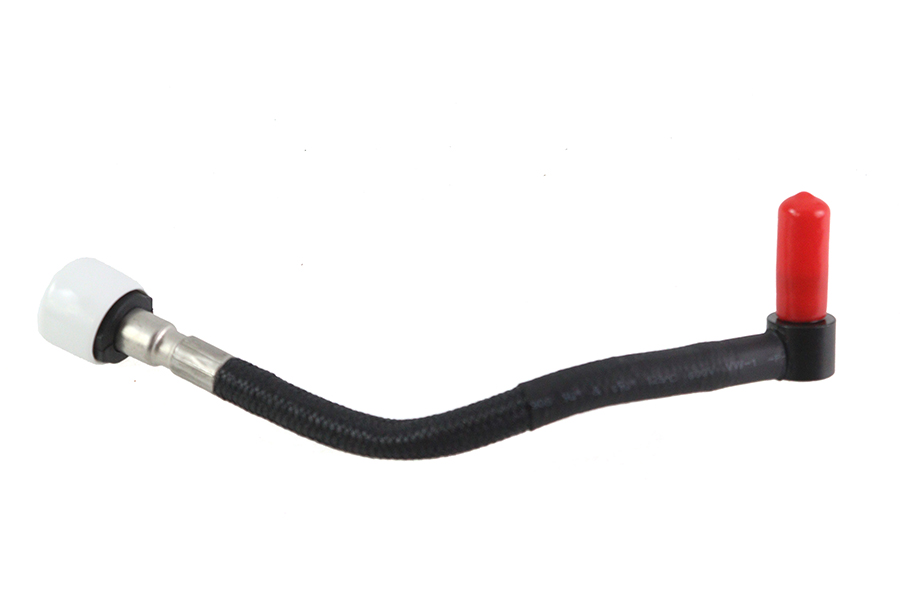
Withdraw the old line and photograph its route. Our catalogue's FLT lines come in year spans of 2002-06, 2008-16, 2012-16 and 2017-20, so match the year rather than a picture. Each opened fitting gets brand new O-rings, given that an aged ring from a stored bike is often the actual leak. These are single-use parts anyway.
Seat, lock and pull-test each connection, then restore the retainers. Hose and a clamp must never stand in for this line, however old the bike is or however little you plan to ride it.
Waking the bike up again
On EFI, restore the pump circuit and then the battery, and switch on without starting. Let it prime, inspect everything, switch off and repeat a few times, as a tired pump can take a moment. Fresh fuel only. On either type, hold off starting until joints stay dry.
When it does fire, stay with it. Inspect at idle and at full warmth, then again the next morning before you ride, since a slow seep from an old part elsewhere may only show overnight.
Mistakes that cost money
- Buying a line before checking the O-rings.
- Blaming the line for poor running caused by stale fuel.
- Assuming an old dresser is carb or EFI because of its age alone.
- Levering a stiff connector against the tank port.
- Refilling with the old fuel you just drained.
When to stop
Pass it to a shop if the connector will not release, the port is corroded, there is rust in the tank, or the hose was shedding bits and the bike still runs badly after the swap.
Parts for this job
Check fitment for your own model and year before ordering — add your bike and we will flag what fits.
Other Harley how-to guides
This guide covers procedure and judgement. Torque figures, fluid capacities, gaps and tension settings are specific to your model and year and must come from the factory service manual for your motorcycle — we deliberately do not print numbers we cannot stand behind for your bike. Independent aftermarket retailer, not affiliated with Harley-Davidson, Inc.